PVA Water Absorbing Block vs Sponge: Which Clears Water Faster?
A PVA water absorbing block locks water in on contact, where an ordinary household sponge cannot keep up. Here is where that difference matters.
Esta página aún no está traducida y se muestra en inglés.
A PVA water absorbing block pulls water off a surface and locks it inside the block the moment it makes contact. Poured with the same 200 ml of water at the same time as an ordinary household sponge, the block took the water in from its surface straight away, while the sponge could not lock it in anywhere near as fast. If the job is to make water disappear in a single pass, that is the whole difference.
What is the AION water absorbing block?
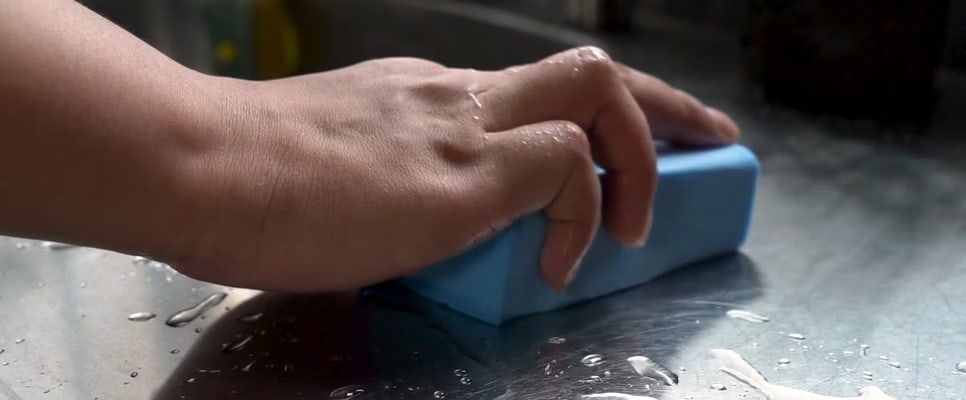
It is a block made from a special PVA sponge, measuring 11 x 6.5 x 3.5 cm, which is small enough to hold and work with in one hand. You wipe in one direction and it lifts the excess water away as it goes. Once the block is saturated you simply squeeze it, and its absorbency comes straight back, so a single block keeps working through a long job instead of being swapped out.
How is it different from an ordinary sponge?
The two were tested with the same 200 ml of water, poured at the same time so the uptake could be watched side by side. The block locked the water in from the surface layer into the body of the block immediately. The household sponge could not lock water in at that speed, and the difference in instant absorption was plainly visible.
That matters in practice, not just in a demonstration. A sponge that absorbs slowly pushes water ahead of it, so you chase the same pool back and forth across a surface. A block that takes water in on contact clears the area in the pass you have already made.
Where is it most useful?
Anywhere water sits where it should not, and especially anywhere you cannot simply rinse and let dry:
- Windows and window frames, where water runs down and collects along the edges
- Condensation formed by a hot-to-cold temperature swing, including in bathrooms
- Helmet liners and similar padding that cannot be washed with water
- Sinks and work surfaces, where washing inevitably splashes
On soft or awkward surfaces the technique is to press rather than scrub. The block draws out the excess water and the dirt carried with it, and holds that dirty water inside instead of letting it spread outwards.
How do you use it?
- Wipe in one direction across the wet area rather than working back and forth.
- When the block feels saturated, squeeze it out. Absorbency returns immediately.
- On liners, padding and anything you cannot soak, press the block down and lift it rather than rubbing.
- Squeeze it out again and let it dry before storing it.
Why keep one in a detailing kit?
Detailing puts water everywhere a drying towel is not: door shuts, window channels, mirror housings, panel gaps, the rim of a bucket, the bench itself. A block that takes water in on contact and gets its capacity back with one squeeze covers all of those without turning into a pile of damp towels.
Size is part of it. At 11 x 6.5 x 3.5 cm it sits in a caddy, comes out one-handed and goes back in wet, which means it actually gets used rather than left behind at the wash bay.
Is it easy to sell?
For distributors it is a straightforward add-on line. It is not colour-sensitive or paint-sensitive, it needs no chemical knowledge to explain, and it demonstrates itself in about ten seconds: pour water on a counter, wipe once, squeeze the block out over a sink. Customers who have only ever used a household sponge tend to understand the difference the first time they see it.